What Way Too Many Therapists Get Wrong About Eating Disorders
Photo by Diana Polekhina on Unsplash
I'm Carrie Smolen, a Los Angeles-based therapist specializing in perfectionism and body struggles, including eating disorders. I spent the early part of my career working in partial hospitalization and intensive outpatient eating disorder treatment — and what I learned there fundamentally changed how I think about who is at risk, who gets diagnosed, and who gets left behind. This post is for anyone who has ever felt like their relationship with food and their body didn't quite "count."
I spent the bulk of my first year after graduating from therapy school working in partial hospitalization and intensive outpatient eating disorder (ED) treatment. I didn’t apply to grad school thinking that I would be drawn to this work, though I probably should have guessed that it would come naturally to me. Like in any program worth its salt, much of my first year was spent considering my own struggles and learning about all of the different ways that my personal experiences could (both positively and negatively) impact my clinical work. By the time I was through, I had developed not only significantly more understanding about my own eating disorder history, but also a passion for helping others through their recovery.'
A lot of therapists say that they won’t work with eating disorders, and I can understand why. According to the National Eating Disorders Association (NEDA), eating disorders have the second highest mortality rate of any psychiatric illness, behind opiate addiction. They also carry an increased risk of both substance use disorder and suicide attempts. But NEDA also notes that 9% of the US population (as of 2020) has an eating disorder. Given what we’ve all been through, plus the cultural shift that has occurred (thanks in no small part to the rapid rise of GLP-1 use) since then, I would be shocked if that number weren’t higher now. This also obviously doesn’t account for all of the people that have a disordered relationship with food, exercise, and/or their bodies, but are never formally diagnosed and therefore not part of that statistic.
So there’s a good chance that any therapist with a caseload of 20 is currently seeing at least 2 clients dealing with some level of disordered eating, if not a “clinically significant” eating disorder. NEDA also sites a study from 2023 which found that 22% of children and adolescents worldwide show disordered eating. A therapist working with kids and/or teens is even more likely to already be seeing clients that exhibit concerning behaviors around food/movement and/or attitudes toward their bodies. It’s easy for practitioners to write eating disorder sufferers off as a separate subset of the population, only to find themselves working with a client that raises cause for ED suspicion after coming in for an entirely separate issue.
I’ve had several experiences with colleagues who want to consult with me about a client after finding out that I treat eating disorders and specialize in body struggles. I very much appreciate being a resource for these clinicians, and the conversations have always been nuanced, curious, and compassionate. At the same time, too often the therapist will either start with their experience of observing their client’s body or lament (sometimes apologetically) their inability to get a full picture of what the client’s body looks like, either due to clothing choices or by virtue of seeing the client via telehealth. More often than not, an attempt at a subjective weight-centered physical assessment comes before any discussion of anything the client has actually said.
Way too many therapists believe that it is possible to tell whether or not a person has eating disorder by looking at the size and shape of their body.
A person that is “unusually” thin sets off alarm bells for anorexia nervosa. A person in a larger body prickles the instinct to assess for binge eating disorder. The biggest problem with this line of thinking is that bodies respond very differently to behaviors around food and movement (based on a plethora of genetic and biological factors), so the way someone physically appears is an unreliable source of information about what is actually happening for them. I say none of this to shame other therapists, especially because I get that this area isn’t everyone’s passion, but instead to highlight a systemic problem that can get in the way of people’s receiving care that could change their lives for the better.
A huge part of the issue is that many therapists are not actually taught much at all about how to screen for eating disorders. I remember only one lesson in one class of my master’s program that had been dedicated to discussing them at all. In that lecture, we talked about To the Bone (2017) a movie featuring a very thin, white, college-aged girl… the exact type of person that most of our mind’s eyes conjure when thinking of an ED sufferer. If I hadn’t personally taken such an interest and devoted several independent projects to the subject, I’d probably have finished school knowing next to nothing about eating disorders too. I even had a professor ask my take on a private practice client after a presentation I gave. Many therapists don’t actually know what to look for unless they see a body that they deem atypical at either end of the size spectrum.
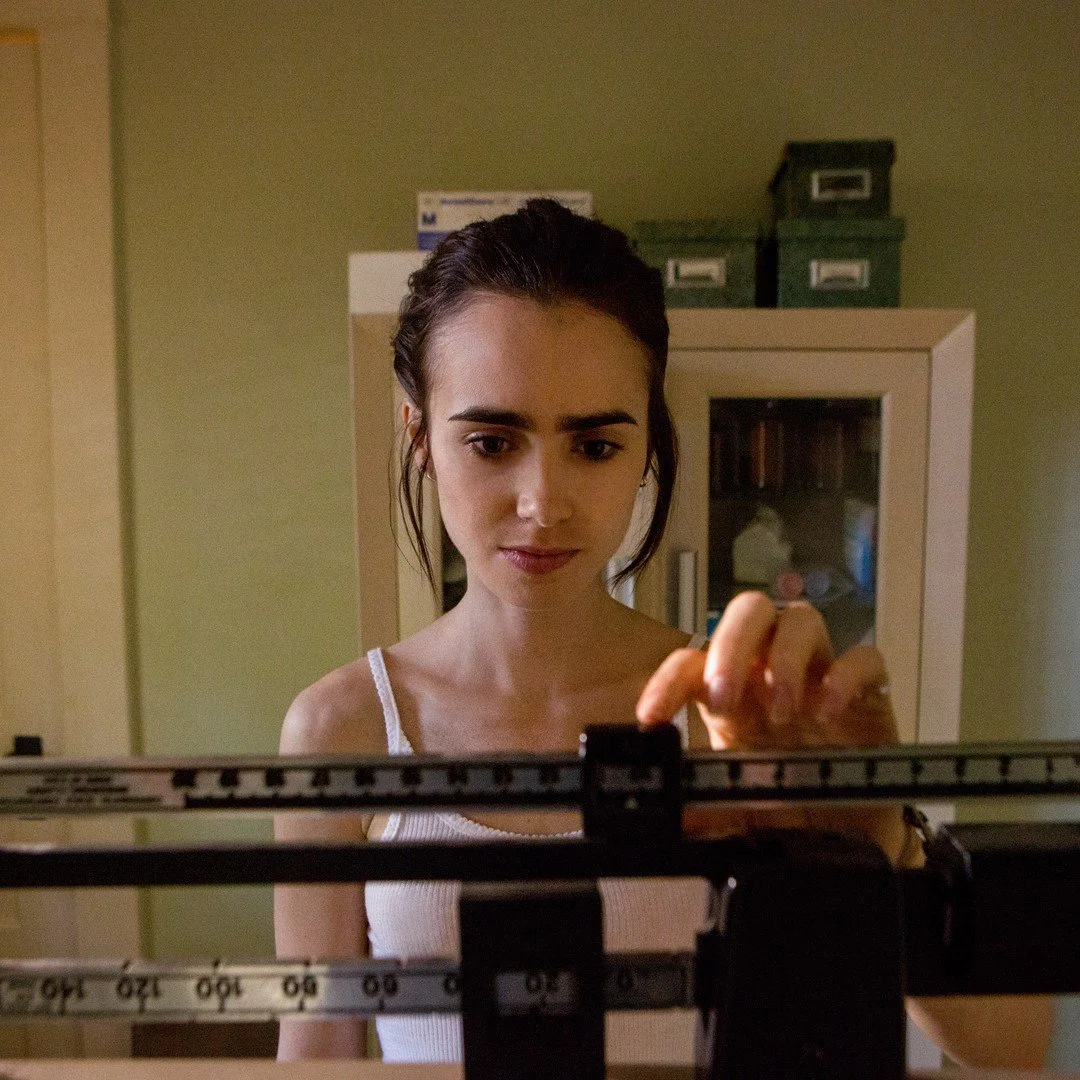
Lily Collins in To the Bone (2017)
Spotting eating disorder warning signs is especially confusing because so many attitudes toward food and exercise that our culture celebrates (especially in a city like Los Angeles) are what I, and other eating disorder specialists, would consider cause for concern. For people whose weight is considered in or above the “normal” range, behaviors that one might flag for an “underweight” person are supported and praised. The slope between impressive discipline and worrying obsession, especially for those of us that tend toward perfectionism, is so slippery that it might as well be a cliff.
Here are some eating disorder facts from NEDA (more at that link) that challenge typically held perceptions about who is at risk and worth assessing:
Less than 6% of people with an eating disorder are medically underweight.
People in larger bodies have a 2.45 times greater chance of engaging in disordered eating behaviors than straight-sized peers, but receive a clinical eating disorder diagnosis half as often.
Atypical anorexia nervosa (AAN) (anorexia nervosa, except that the person is within a “normal” or higher weight range) occurs more frequently than anorexia nervosa, however fewer individuals with AAN are referred or admitted to eating disorder treatment. Insurance is also less likely to cover care for AAN.
People of color (Hispanic/Latina/o, Black/African American, and Asian Americans) are more likely to engage in disordered eating behaviors than their white counterparts, but are half as likely to be diagnosed or to receive treatment. Youth of color are less than two thirds as likely to receive recommended treatment compared with white youth.
LGBTQ+ adults and adolescents experience greater incidence of eating disorders and disordered eating behaviors than their heterosexual and cisgender counterparts.
Prevalence rates for eating disorders have been shown to be higher in athletes than non-athletes, ranging range from 6-45% in female athletes and 0-19% in male athletes. A recent study reported that 86% of competitive athletes met criteria for an eating disorder or disordered eating.
Rates of eating disorders in males are increasing at a faster rate than for females. (Macro-counting gym bros, how you doing?)
So since just looking at a person’s body is NOT a great predictor of whether or not they have an eating disorder, here are some common warning signs and symptoms to look for (again, more at that link, including breakdown by ED):
Behavioral/Emotional/Cognitive
Preoccupation with weight loss, food, calories, and dieting, including refusal of certain foods or food groups and/or rigid tracking
Development of food rituals, rules, or unusual eating behaviors, including a strong preference to eat alone and/or on a certain schedule
Avoidance of mealtimes and situations involving food, or general withdrawal from social situations; possibly increased isolation and/or secrecy
Excessive thinking about/planning food and/or anticipating food served at events
Extreme concern with body size and shape, potentially including frequent checking behaviors such as looking in the mirror and/or measuring/weighing
Fear of weight gain
Maintaining a strict and inflexible exercise regimen (especially despite illness/injury/etc.), especially if it interferes with other activities
Drinking excessive amounts of water and/or using excessive amounts of mouthwash, mints, or gum
Compensatory behaviors after eating
Sneaking or hoarding food
Increasingly “picky” eating
Fear of choking/vomiting
Developmentally inappropriate consumption of non-food items
Extreme mood swings
Difficulty concentrating
Inability to feel hunger and/or fullness cues
Feeling out of control around food or while eating
Shame and guilt (especially after eating or when unable to exercise)
Self-esteem overly related to body image
Physical/Medical
Noticeable shifts in body size, up or down (yes, this is a potential sign… just certainly not the ONLY one)
Gastrointestinal complaints
Abnormal laboratory findings
Impaired immune function
Poor wound healing
Muscle weakness
Dizziness (especially upon standing) and/or fainting/syncope
Feeling cold all the time (potentially dressing in many layers)
Sleep concerns
Dental problems
Dryness or thinning of hair/skin/nails
Fine hair on body (lanugo)
If you are a provider (whether a fellow therapist or other health professional), and you pick up on any of these signals in someone with whom you’re working, I strongly recommend that you consult with an eating disorder specialist to get a better sense of how you can best support your client. I would be happy to chat. And if you yourself resonate with anything on this list, even if you’re not sure if what you’re experiencing is actually disordered, I encourage you to touch base with an eating disorder professional (such as a therapist like me, or a registered dietitian) to discuss options for support.
I am so grateful that my first therapist in LA was well-informed about eating disorders. When she was preparing to retire and gathering referrals for me, she gently asked if I would be open to my next provider being an eating disorder specialist. I was somehow both surprised and unsurprised, and thankfully I said sure. Without that nudge (despite my not physically appearing “typically” anorexic), my disordered relationship with food and exercise very well might have intensified. Through working with an outpatient therapist specializing in eating disorders, I was able to prevent progression and work toward recovery without needing to pursue a higher level of care. It’s an honor to now to be on the other side of that therapeutic alliance, getting to help others find their way toward a more peaceful relationship with food, movement, and their bodies.
If anything in this post resonated — whether you're a provider looking to consult, or someone who suspects their own relationship with food and their body deserves more attention — I'd encourage you to reach out. I offer virtual therapy for body struggles and outpatient eating disorder recovery across California. Book a free consultation.
Duck Syndrome is a Substack for overwhelmed perfectionists and anxious overthinkers— people who look like they have it all together while paddling frantically under the surface. If this resonated, there's plenty more where it came from.
Read the full archive and join the flock on Substack →
VIRTUAL THERAPIST • LOS ANGELES
Hi, I’m Carrie (she/her).
A therapist for thoughtful, overwhelmed humans trying to be good people in a complicated world.
As a therapist for folks all over California, most of my work centers on helping clients with issues related to perfectionism and body struggles, including eating disorders.
I love to come along for the ride as people get clearer on who they are, what they need, and how to move through life with more ease, self-trust, and permission to be unapologetically imperfect.